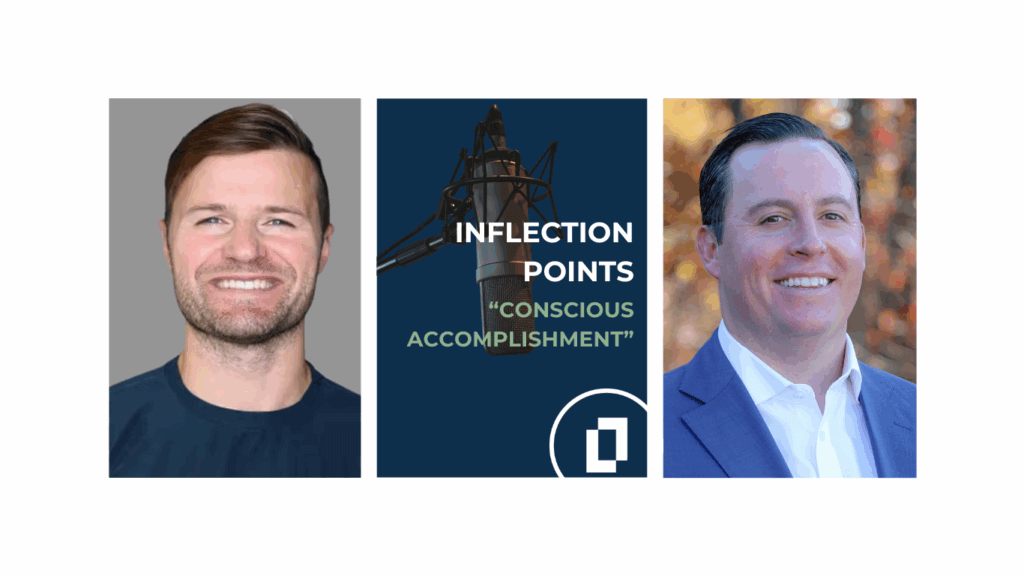
Inflection Points: “Conscious Accomplishment”- 10 Questions with Scott Britton
Inflection PointsDec 16, 2025
In an effort to bring useful information to clients in different ways, this is our second written interview for Inflection Points. Scott Britton is an entrepreneur, author, and investor who’s spent his career building businesses and communities around meaningful work. He co-founded Troops, a software company that was acquired by Salesforce in 2022. Today, he’s building Conscious Talent, a recruiting firm that connects high-performing entrepreneurs and executives who care about both professional excellence and personal growth. He is also the host of the Podcast EvolutionFM, a top 1% podcast in the world.
Scott’s story is one many ambitious professionals can relate to- after years of struggling despite achieving material success, Scott found himself completely burned out and miserable. In his recently released book, Conscious Accomplishment, Scott tells his personal story and explores how achievement and self-development can reinforce each other rather than compete.
Recently, Senior Wealth Advisor Mike Cordaro connected with Scott to discuss his unique career path, his new book and how busy professionals and entrepreneurs can accomplish their goals in a more balanced way.
1. Cordaro: Scott, I really enjoyed the book. It spoke to some of my own struggles, as I’m sure it does for so many others. To start, can you explain what you mean by “consciousness”? It’s a term that gets thrown around a lot these days. What’s a simple way to think about it?
Britton: Thank you, I’m glad you enjoyed it. In this book, Consciousness references our subjective experience and the overarching perceptual system which creates it. For example, you are conscious that you are reading this article. And patterns in your subconscious mind are comparing what you’re reading to your past and creating meaning from it.
2. Cordaro: In these interviews we explore how people made important decisions in their lives. Tell us about your path. How did you go from being an Ivy League educated hard-charging professional in New York City obsessed with productivity to an author exploring unconscious patterns and spirituality?
Britton: It’s really simple. That whole way of living stopped working. Despite seemingly having the perfect life on the outside, I gradually began to recognize that I was very unhappy. I had been a meditator for six years at this point and already gone to therapy and realized I needed something more drastic to shake things up. I decided to take my friend up on an invitation to experience plant medicine, which is where I experienced my first altered state of consciousness. During this experience, it was the first time I connected with an inner wisdom and was able to see a deeper truth about myself and reality.
From that point on, exploring this became far more interesting than making more money, exotic vacations, productivity, or any of the other things I once was obsessed with. About a year into that journey, I met a teacher and realized that all of my problems in life were mostly from a lack of awareness and aspects of my consciousness that needed to be faced and examined.
3. Cordaro: Most people do not spend a lot of time thinking about this stuff. How do you make it digestible and useful to make people’s day to day lives better?
Britton: Any time you’re disturbed, it is pointing to an aspect of your consciousness that is unlike your true nature. You can use these experiences to go inward and start to investigate the unconscious patterns running your life. The best way to go about this is to start noticing every time you’re triggered or disturbed and write it down. From here, you can use contemplative practices to examine and transform them.
4. Cordaro: How do you get people comfortable opening up about such personal topics?
Britton: For me, it’s just about leadership. Everyone wants to talk about deep and sacred things that matter. They’re just too afraid to do it because of unconscious patterns around fear. When you start to speak publicly about these things, it gives others permission to do the same. For anyone who is afraid to do that, I think it’s important to recognize that owning your truth and authenticity will simply polarize people. People that share similar interests and values will be more interested in you. Those that are not aligned will simply fall away. In most cases the catastrophizing we do internally about sharing these aspects of ourselves never really happens.
5. Cordaro: The book covers some deep subject matter, but you also pair it with practical tips people can use day-to-day to become more aware of what drives their behavior. What is a “Freedom Log,” and how did it help you?
The Freedom Log is a note you use to write down every time you’re disturbed, triggered, or resisting reality as it is. These moments serve as pointings to the unconscious patterns running your life. Writing them down is the first step in bringing awareness to them which you can then later bring them into a contemplative practice. The one I write about in the book is called Repatterning and you can read a bit more about it here.
6. Cordaro: A key theme in the book is stepping back to understand our recurring behavioral patterns. You write that many of these behaviors are “inherited” without us even realizing it. What do you mean by that?
Britton: Our consciousness is constantly snapshotting information in order to build a mental model of reality. In order to help us navigate life safely and efficiently, it constructs patterns which are like shortcuts that say if you experience this, perceive and respond this way. That’d be fine if all the patterns were healthy and supportive, but they’re not. A large portion of our ways of relating to life are being driven by experiences that happened to us a decade ago that we didn’t even choose. These include things like advice our parents gave us to stuff that happened on the playground. To become the authors of our experience (vs. the subjects) we must identify and face these things.
7. Cordaro: Let’s bring this to a topic we discuss often with clients—money. How do scarcity and other common patterns show up in people’s finances and lives more broadly?
Britton: Great topic! Anytime finances make you nervous, you’re likely operating from a paradigm that there are a scarce amount of resources. This could show up when you’re paying your credit cards, receive a large bill, or giving the option to tip someone. How you relate to these situations is a direct reflection of the patterns in your consciousness. You can tell yourself you’re very abundant, but if these situations cause you to close and cling, it’s likely there’s concepts around scarcity patterns ruling your consciousness.
8. Cordaro: Talk about the importance of “acceptance,” as you describe it in the book.
Acceptance is learning to look objectively at reality and facing the truth. This could be how you feel in a given moment or how a circumstance unfolded. When we fight reality by trying to control it, life is difficult. When we learn to increasingly accept it as it is, there’s much more room for ease, clarity and creativity.
9. Cordaro: One big concept you write about is that our “outer world” often reflects our “inner world”. Explain what you mean by that.
The outer world reflects our inner world, though fundamentally, I believe they are two aspects of the same thing. Most people think their problem is the outer world doesn’t look the way they want it to. However, it’s really their relationship to the external world that creates their experience and this is defined by their consciousness reference system (inner world). As you go deeper on the consciousness journey, you start to see a deeper cohesion of how the inner world influences reality itself. This is a bigger concept though probably best saved for the book!
10. Cordaro: Knowing what you know now, what advice would you give your 22-year-old self?
Britton: Happiness is an inside job. You’re problems are consciousness problems, and you can start to work on them by going inward when you are taken out of a calm, peaceful state.
Disclosures: Alliance Wealth Advisors, LLC (“Alliance”) is an SEC Registered investment advisory firm that is independently owned and operated. The information in this interview is provided for informational purposes only and should not be taken as investment, legal, or tax advice. Opinions expressed in this interview are subject to change without notice. It is important to remember that investments in securities involve risk, including the potential loss of principal invested. Past performance is no guarantee of future results and diversification does not guarantee a profit or protect against loss in a declining financial market. Alliance does not guarantee the suitability or potential value of any particular investment or strategy and accepts no liability for reliance on this presentation. Alliance also does not make any representations as to the accuracy, timeliness, suitability, completeness, or relevance of any information prepared by any unaffiliated third party mentioned in this communication and takes no responsibility. Our guest, Scott Britton, did not receive any compensation for this interview, not otherwise affiliated with, the firm and not client of Alliance Wealth Advisors at the time of this publication. For more information regarding Alliance, please visit alliancewealthadvisors.com/legal-disclosures