
The Illusion of Perfection
Investment ManagementApr 14, 2026
The Masters is the first major championship of the golf season and, more importantly for many, an annual reminder that spring is officially here. On Sunday, Rory McIlroy won his second consecutive green jacket. While he became only the fourth player to repeat as champion, it was far from a perfect performance. He nearly gave up a historic lead, but he stuck to his plan, stepped up with big shots when it mattered, and did enough to win.
What does this have to do with investing? Perhaps more than you think. While no one at our firm will ever be confused with a professional golfer, we’ll explain why.
First, while a round of golf can last hours and tournaments stretch over several days, where a player finishes can be dictated by just a handful of decisions. The same goes for people trying to create, preserve, and grow their wealth, where a few decisions over decades can have an outsized impact. Warren Buffett, who many consider the greatest investor of all time, has said that just ten to fifteen investment decisions are responsible for most of his success over the last six decades. If you removed those from his track record, no one would have ever heard of him.
Second, whether it’s golf or investing, neither is about being perfect. As Rory showed again this year, mistakes and bad outcomes are inevitable. His success didn’t come from avoiding them entirely, but from managing them properly. The key is mitigating mistakes, sticking with your process, and recognizing when negative emotions are driving decisions that can make things worse. Rory has done a lot of work with sports psychologist Bob Rotella, whose best-selling book Golf Is Not a Game of Perfect could serve stressed-out investors well too. This idea becomes even more important in today’s uncertain environment.
After a couple years of mostly smooth sailing, volatility has returned in a big way. With continued geopolitical upheaval due to the conflict in Iran, trade and economic uncertainty, A.I. concerns, and issues in private markets, the constant psychological roller coaster of investing can lead people to make compounding errors that are hard to bounce back from. In the 2008 Global Financial Crisis, many people sold all their stock holdings as the market declined 38%. They couldn’t stomach watching their investments fall further. This happens in every cycle; the people who sell out often don’t get back in.
Ben Carlson explains why this is such a costly mistake:
“Market timing is always difficult, but doing so during a crash makes it exponentially harder. Selling after big losses can bring short-term relief, but it often backfires. You get comfortable in cash, assuming the volatility will continue, and when markets rebound sharply, you hesitate to get back in because you don’t trust the recovery.”
That’s exactly what happened, and many missed the rebound. One year after the market bottomed in the spring of 2009, the S&P 500 was up well over 60%. Two years later, it had nearly doubled. By 2015, the market was up close to 200% from those lows. Carlson goes on to say:
“It’s bad enough you have to sit through massive drawdowns in the stock market on occasion. But if you take the beatings and miss out on the subsequent gains, you end up losing twice.”
Not only do we not know when a sell-off will begin or end, it can also become incredibly hard to make up for negative returns once an investor has locked in losses. The chart below shows how large your gains need to be to recoup realized losses:
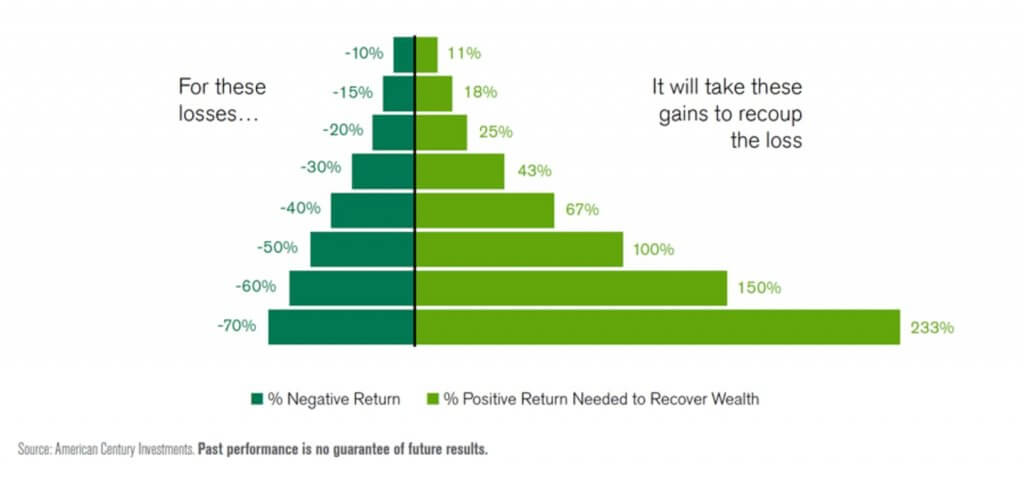
While we can’t control outcomes in golf or in the financial markets, we can control how we prepare and respond to the inevitable ups and downs along the way. A good financial plan should be built around your specific situation and help insulate you from short-term volatility that can lead to mistakes. It’s not about having perfect timing, judgment, or investment products. Those are illusions we’re tempted to chase.
We need to play a different game. Whether it’s golf or financial planning, success doesn’t come from trying to be perfect. That’s unrealistic. As Rory’s career (and his latest win) shows us, it comes from building a process that allows you to improve over time, staying resilient, avoiding the big mistakes in the wrong moment, and adapting as conditions change.
Citations:
One of the Biggest Mistakes in Investing, Ben Carlson, A Wealth of Common Sense, March 31, 2023
Golf and Investing: More in Common than You Think, American Century Investments, July 9, 2020
It is important to remember that investments in securities involve risk, including the potential loss of principal invested. Past performance is no guarantee of future results. Diversification does not guarantee a profit or protect against loss in a declining financial market. Alliance also does not make any representations as to the accuracy, timeliness, suitability, completeness, or relevance of any information prepared by any unaffiliated third party mentioned in this communication and takes no responsibility. This is not intended to be individual tax or legal advice. Please consult your tax or legal professional. Additional disclosures can be found by visiting alliancewealthadvisors.com/legal-disclosures.